-
Email sales@cherryplastics.com
-
Call +92 334 3195599
Email sales@cherryplastics.com
Call +92 334 3195599
Choosing between plastic pallets and wooden pallets is not just a material preference. It is a decision that directly affects shipping costs, product hygiene, warehouse efficiency and long-term operating expenses. In Pakistan, where industries ranging from food processing to pharmaceuticals rely on palletized logistics, the right pallet type can reduce damage, lower replacement cycles and meet export compliance requirements that wooden alternatives often struggle with.
Most businesses treat pallets as a background cost, something purchased in bulk without much evaluation. But the wrong pallet creates problems that compound over time, broken boards that damage products, wood splinters that contaminate food shipments, fumigation costs for every export consignment and replacement cycle that quietly drain budgets.
In Pakistan's logistics environment, where containers move through Karachi's port terminals in high heat and humidity, pallet durability and hygiene become even more critical. A pallet that absorbs moisture, warps after a few cycles or fails an ISPM-15 inspection at the destination port is not saving money regardless of how cheap it was to buy.
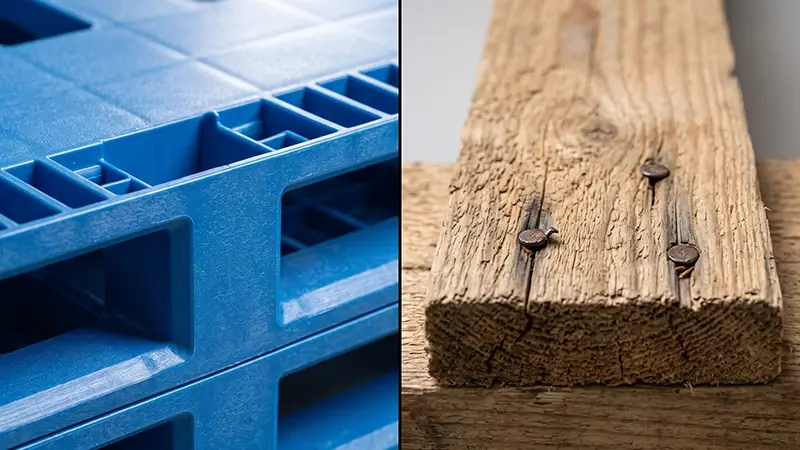
Wooden pallets are made from softwood or hardwood timber, nailed or screwed together. Quality varies widely depending on the wood source, moisture content at the time of construction and fastener type. Low-grade wooden pallets are prone to splitting, nail protrusion and uneven surfaces.
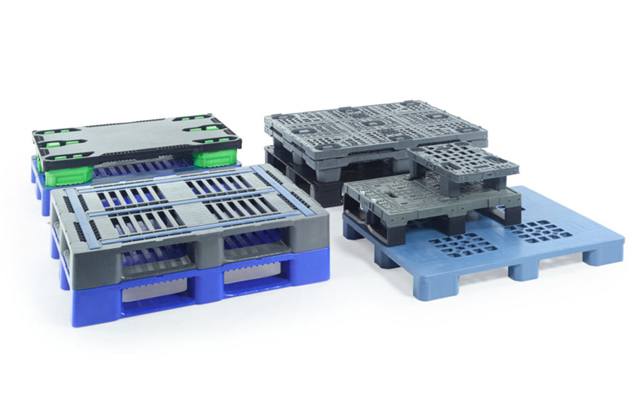
Plastic pallets are injection-molded from polypropylene (PP) or high-density polyethylene (HDPE) as a single uniform structure. There are no nails, screws or joints that can work loose. The material is consistent from one unit to the next and the molding process allows for precision features like fork entry guides, anti-slip surfaces and integrated stacking lugs.
A wooden pallet that looks identical to another in the same batch may perform differently because the wood grain, knot placement and moisture absorption vary piece to piece. Plastic pallets do not have this inconsistency, which matters when you are loading high-value goods or stacking multiple layers in a warehouse racking system.
This is where the comparison becomes significant for any cost-conscious business.
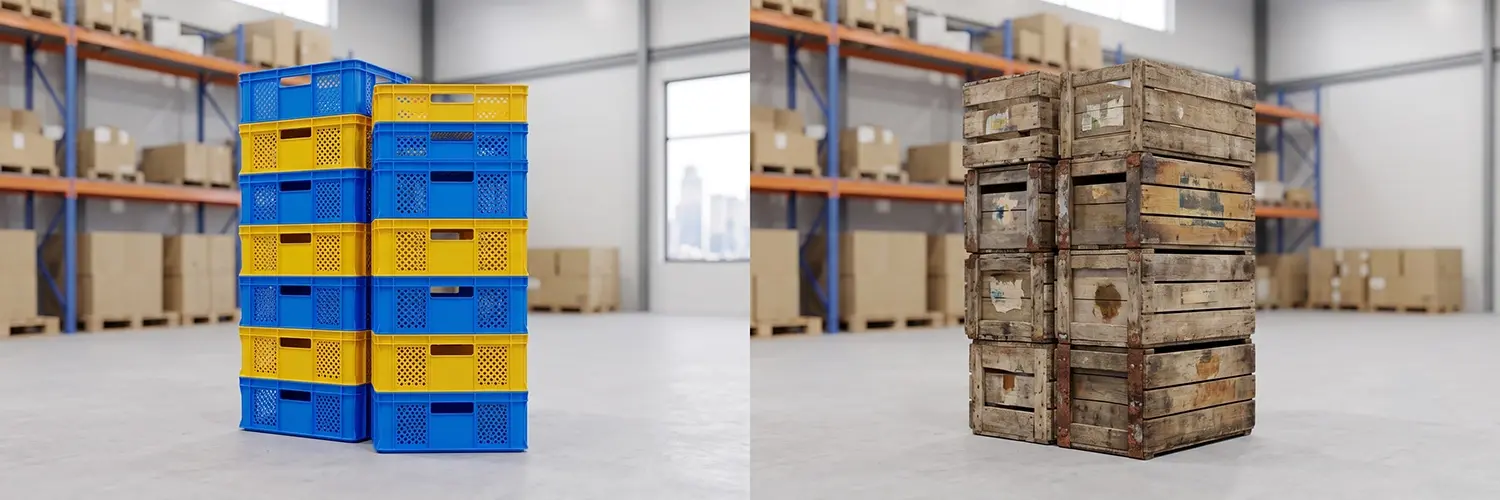
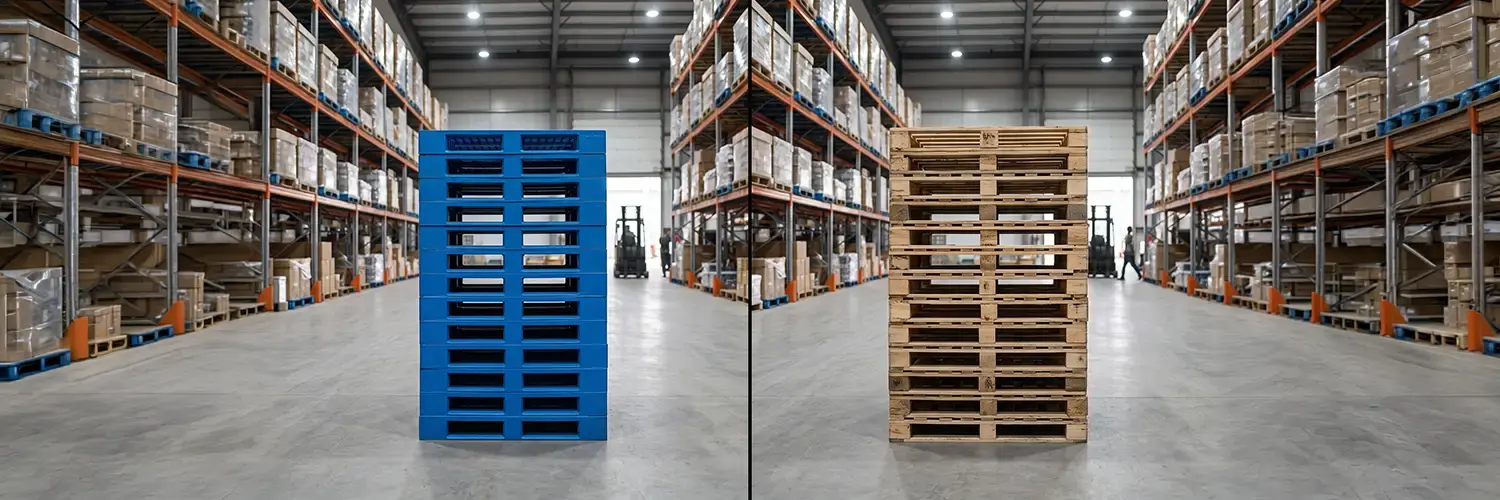
A standard wooden pallet in Pakistan lasts about 15 to 25 trips before it needs repair or replacement. Boards crack, nails bend and humidity speed up deterioration. A quality plastic pallet, by contrast, handles 100 to 250 trips under similar conditions. It does not absorb moisture, does not warp in heat and holds its shape through repeated forklift handling.
If your operation moves 500 pallets per month and wooden pallets last 20 cycles on average while plastic pallets last 150 cycles, you will replace your wooden pallet inventory roughly 7.5 times for every one replacement cycle of plastic pallets.
This is one area where plastic pallets hold a clear advantage over wood and it matters enormously for food processing, pharmaceuticals and any export-oriented business subject to buyer audits.
Wooden pallets absorb liquids, harbour bacteria and cannot be effectively sanitized once contaminated. Mould growth in Pakistan's humid climate is a persistent issue and fumigation only addresses pest control, not microbial contamination.
Plastic pallets are non-porous. They can be pressure-washed, steam-cleaned or chemically sanitized and returned to service the same day. This makes them the standard choice for:
Businesses pursuing HACCP or BRC certification often find that auditors flag wooden pallets in production and storage areas. Switching to plastic pallets removes this audit risk entirely.
A standard wooden pallet weighs between 20 and 30 kg depending on construction. A comparable plastic pallet, such as the PP 1210 4S, weighs just 10 kg, cutting manual handling strain in half.
This weight difference matters in three ways:
In racking environments, the Lightweight Plastic Pallet (PP 1210 4S) Rack variant is specifically reinforced for beam-supported storage while maintaining the same lightweight profile, ensuring load distribution across rack beams without adding unnecessary weight to the system.
This is the section most businesses get wrong. A wooden pallet costs less to buy, and that initial price difference is the only number many procurement teams see.
A new wooden pallet in Pakistan typically costs between PKR 800 and PKR 2,500 depending on size, wood type and construction quality. A comparable plastic pallet costs between PKR 3,000 and PKR 8,000.
When you factor in replacement frequency, repair costs, fumigation charges for exports, pest management and product damage caused by pallet failure, the picture reverses:
For export-oriented businesses, eliminating ISPM-15 fumigation costs alone can offset the higher purchase price within the first year.
Any business exporting goods from Pakistan on wooden pallets must comply with ISPM-15 (International Standards for Phytosanitary Measures No. 15). This requires heat treatment or methyl bromide fumigation of all solid wood packaging material, along with proper IPPC stamp certification.
Plastic pallets are exempt from ISPM-15 entirely. No fumigation, no heat treatment, no certification, no inspection delays at destination ports.
For businesses shipping regularly through Karachi Port or Port Qasim, this means:
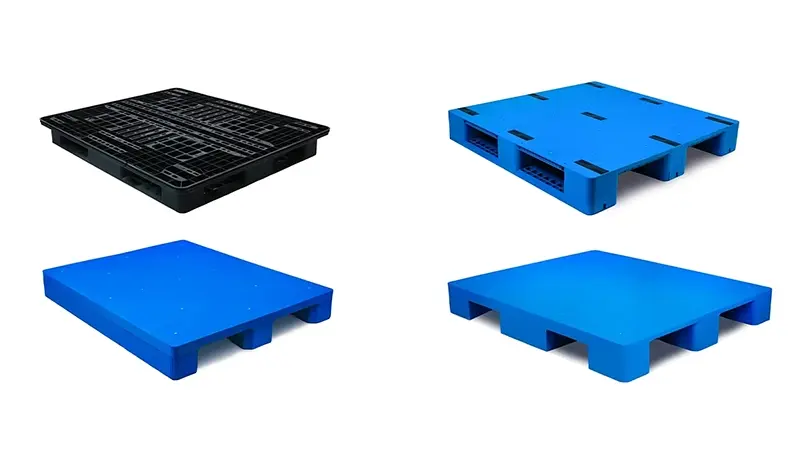
Load capacity is where product selection within the plastic pallet category becomes important. Not all plastic pallets are built for the same weight classes.
Cherry Plastics offers several configurations to match different load requirements:
Wooden pallets do not have standardized load ratings in Pakistan's market. Capacity depends entirely on wood species, moisture content and construction quality, which makes it difficult to guarantee consistent performance across a pallet inventory.
Wooden pallets are biodegradable, but their short lifespan means more trees harvested over time. Damaged wooden pallets that cannot be repaired end up in landfills or are burned, contributing to deforestation and air pollution. The fumigation chemicals used for ISPM-15 compliance add another environmental cost.
Plastic pallets last significantly longer, reducing overall material consumption. At end of life, polypropylene pallets are fully recyclable and the recycled material can be used in new pallet production or other plastic products. Many manufacturers, including Cherry Plastics, use recyclable PP in their pallet range.
When measured by total environmental impact per trip over a pallet's full lifecycle, plastic pallets typically produce a lower carbon footprint than wooden pallets despite being a petroleum-based product.
While any business using palletized logistics can benefit from the switch, certain industries see the most immediate return:
Selecting the right pallet is not just about choosing plastic over wood. Within the plastic pallet category, the right configuration depends on your specific operation.
Consider these factors:
The comparison between plastic pallets and wooden pallets is not close when you evaluate total cost, hygiene, durability and export compliance. The wooden pallets disadvantages pile up quickly, from constant replacements and fumigation charges to contamination risk and product damage that eat into your margins over time.
For businesses that need reusable plastic pallets for warehouse, cold storage or export operations, Cherry Plastics delivers measurable savings that compound with every shipment cycle. To find the right plastic pallets price in Pakistan for your volume and industry, get in touch with Cherry Plastics and see the difference firsthand.
1. Are plastic pallets more expensive than wooden pallets?
The upfront cost is higher, but total ownership cost over 3 years is typically lower due to longer lifespan and zero fumigation or repair expenses.
2. Do plastic pallets require ISPM-15 fumigation for export?
No, plastic pallets are fully exempt from all ISPM-15 requirements including fumigation, heat treatment and IPPC certification.
3. What is the maximum load capacity of a plastic pallet?
Standard models handle 4,500 kg static load, while steel-reinforced variants like the PP 1212 4S support up to 5,000 kg.
4. Can plastic pallets be used in cold storage environments?
Yes, they resist moisture absorption, mould growth and maintain structural integrity in sub-zero temperatures.
5. How many trips does a plastic pallet last compared to wood?
A wooden pallet averages 15 to 25 trips, while a plastic pallet lasts between 100 and 250 trips under comparable conditions.
Copyright 2026 © All Rights Reserved
Designed & Developed by : Digital Hyperlinks (PVT) LTD.